
Quick Information
| Tuition Fee | £37,380–£62,820 per year (2026–27, overseas undergraduate; clinical medicine higher) |
|---|---|
| Last Verified Date | November 10, 2026 |
The University of Oxford is a public research university in Oxford, England, with teaching recorded as far back as 1096 — the oldest university in the English-speaking world. It is a collegiate university made up of 39 self-governing colleges and four permanent private halls, and about 43% of its students are international.
Course Fees
| Programme | Tuition fee (per year) | Notes |
|---|---|---|
| Undergraduate (overseas fee status) | £37,380–£62,820 (2026–27) | Depends on the course; clinical medicine costs more. Home fee status: £9,790. |
| Undergraduate (overseas, 2027 entry) | £39,620–£66,580 | Published range for 2027 entry; clinical medicine higher. |
| Postgraduate (taught and research) | Varies by course | No single range is published — check the fee on your course’s official Oxford page. |
Living costs in Oxford for a single full-time student are estimated at £1,405–£2,105 a month for 2026–27, including accommodation (£825–£990 a month), food (£315–£545), personal items and study costs. Application fees: UCAS £34.50 for undergraduate applications; £75 for each graduate application to a taught course and £20 for each graduate application to a research course (fee waivers are available for eligible applicants). Check the exact fee for your course on the official Oxford fees pages before applying: Undergraduate Fees and Funding guide 2026 (official PDF).
Student Reviews
We do not publish student reviews written by us, and we do not invent ratings. Read what students and visitors actually say on the university’s real Google Maps reviews: University of Oxford on Google Maps. If you have studied at Oxford and want to share your experience with future applicants, tell us through our Admission Inquiry page.
Admission Process
Undergraduate applications go through UCAS, and you can apply to only one of Oxford or Cambridge in the same UCAS cycle. The UCAS deadline of 6pm (UK time) on 15 October 2026 for 2027 entry has passed; the next cycle is for October 2028 entry — check the official Oxford admissions page for the date. Shortlisted undergraduate candidates are interviewed in December, and decisions for 2027 entry are sent through UCAS on 12 January 2027. There is one main intake, in September or October.
| Date | Event |
|---|---|
| 15 October 2026, 6pm UK time | UCAS deadline for 2027 entry (passed) |
| December 2026 | Interviews for shortlisted candidates |
| 12 January 2027 | Decisions sent through UCAS (2027 entry) |
For Indian undergraduate applicants, above 90% in CBSE or CISCE is needed, with 95% or above in four relevant subjects. Some courses also require a subject-specific admissions test, taken in October. Postgraduate applicants need an undergraduate honours degree equivalent to a strong upper second-class — a four-year degree at 60% from Institutions of National Importance or 70% elsewhere, or a three-year degree at 65–70%. English requirements are IELTS 7.0–7.5 depending on the course; TOEFL, PTE and Duolingo are also accepted. Postgraduate deadlines vary by course, and the funding-linked deadlines fall in December 2026 or January 2027 — check the deadline on your course’s official page. The undergraduate acceptance rate is 16.2% and the postgraduate acceptance rate is 26.2%.
Placements and Careers
Oxford does not publish a single overall placement or employment rate, so none is given here. Graduate destinations are reported through the Graduate Outcomes survey — a national survey of graduates 15 months after they leave university, run by HESA (the Higher Education Statistics Agency). The university’s Careers Service publishes the survey results and offers careers advice, appointments, events and the CareerConnect jobs platform to students and to alumni for two years after their course ends. By sector, the Graduate Outcomes Survey 2022 shows 17% of Oxford graduates in research and development, 7% in business and management and 7% in technology (IT, data and AI). For the full survey results, see the Graduate Outcomes Survey — Oxford University Careers Service and the Careers guidance — University of Oxford.
Rankings
QS World University Rankings 2026 place Oxford 4th in the world (down from 3rd in 2025). Times Higher Education (THE) World University Rankings 2026 place Oxford 1st in the world — the tenth consecutive year at the top. U.S. News Best Global Universities 2026 rank Oxford 4th in the world. In the UK, Oxford is 2nd in QS 2026 and 1st in THE 2026.
Campus Gallery
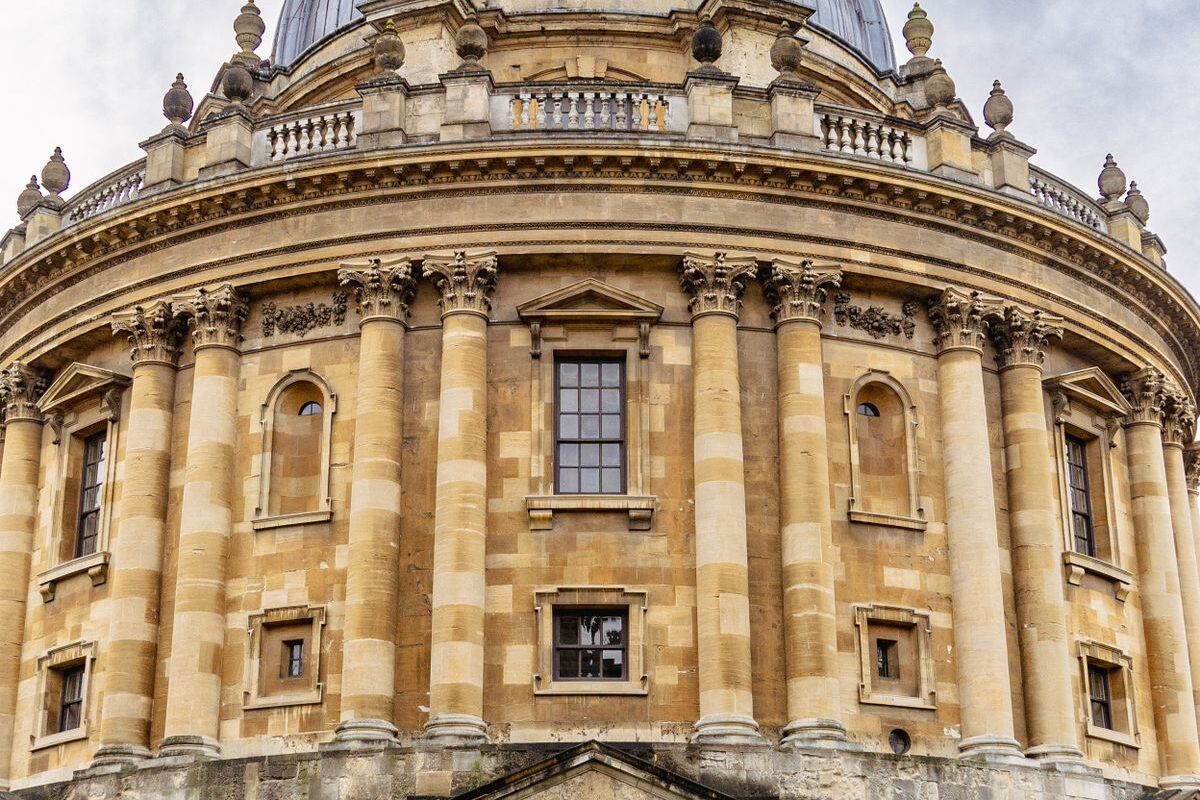
The featured image above shows the Radcliffe Camera, Oxford — verified as a genuine campus photograph. No additional gallery photographs have been added yet: extra campus photos will be added only once each one is verified as Oxford’s own campus (see SPEC.md §6). If you have a freely-licensed photograph of an Oxford college or building, tell us through the Admission Inquiry page.
Campus and Infrastructure
Oxford is not a single campus: teaching and research happen across the central university, its 39 colleges and four permanent private halls, spread through the city of Oxford. The Bodleian Libraries serve the whole university, alongside college libraries, and the university’s museums and collections are open to students and the public. Colleges provide accommodation and small-group teaching (tutorials) for undergraduates, and graduate students are members of both a college and a department. Housing, laboratory and sports details vary by college and department — check the official pages of the college or course you are interested in.
Faculties and Departments
Oxford’s academic departments, faculties and research centres are grouped into four divisions: Humanities; Mathematical, Physical and Life Sciences; Medical Sciences; and Social Sciences, covering roughly 100 departments. Popular courses include Computer Science, Law, Medicine, Mathematics and Engineering, and the university is also well known for Philosophy, Politics and Economics (PPE), the MBA at the Saïd Business School, MSc Advanced Computer Science, Master of Public Policy and BA Jurisprudence. The Saïd Business School holds triple accreditation (AACSB, EQUIS and AMBA).
Compare with Similar Universities
Compare universities side by side with our Compare Universities tool — pick any two universities and see their fees, rankings, intakes and degree levels together. Similar universities on this site: University of Cambridge (QS 2026: 6th in the world), Imperial College London (QS 2026: 2nd in the world), and ETH Zurich (QS 2026: 7th in the world).
Frequently Asked Questions
How do international students apply to Oxford?
Undergraduate applications go through UCAS, and you can apply to only one of Oxford or Cambridge in the same UCAS cycle. The UCAS deadline of 15 October 2026 for 2027 entry has passed; the next cycle is for October 2028 entry — check the official Oxford admissions page on ox.ac.uk for the date. Postgraduate applications are made directly to the university and deadlines vary by course.
What grades do Indian applicants need?
For undergraduate study, above 90% in CBSE or CISCE, with 95% or above in four relevant subjects. For postgraduate study, an undergraduate honours degree equivalent to a strong upper second-class — a four-year degree at 60% from Institutions of National Importance or 70% elsewhere, or a three-year degree at 65–70%.
How much is tuition at Oxford for international students?
For 2026/27 entry, overseas undergraduate course fees are £37,380–£62,820 a year depending on the course, with clinical medicine higher. For 2027 entry the published overseas range is £39,620–£66,580 a year. Postgraduate fees vary by course, so check the fee on the official Oxford course page before applying.
What English test score does Oxford ask for?
IELTS 7.0–7.5 depending on the course. TOEFL, PTE and Duolingo are also accepted. Check the English language requirements on your course’s official page, as the level varies.
Does the Rhodes Scholarship cover Oxford study?
Yes — the Rhodes Scholarship is for postgraduate study at Oxford and covers full course fees plus a living stipend of £21,060 a year for 2026–27, paid monthly. It does not guarantee admission: you must still apply to and be accepted by Oxford separately. Check the official Rhodes Trust page for the current conditions and deadlines.
Does Oxford publish a single placement rate?
No. Oxford reports graduate destinations through the national Graduate Outcomes survey (15 months after graduation) rather than a single placement rate. See the Placements and Careers section above for the survey results and the Careers Service link.
Where can I download the Oxford prospectus?
Oxford no longer publishes a single downloadable prospectus PDF for the whole university — its prospectus is digital. Use the Download Brochure button at the top of this page to open the university’s official digital prospectus page. Individual colleges publish their own prospectuses, but those cover one college only, not the whole university.
Scholarships
Rhodes Scholarship — for postgraduate study at Oxford; covers full course fees plus a living stipend of £21,060 a year for 2026–27. Apply through the Rhodes Trust; you must also be admitted to Oxford separately. Status: check the official Rhodes Trust page for the current cycle. Clarendon Fund — Oxford’s largest graduate scholarship scheme: over 200 new, fully funded scholarships each year for Master’s and DPhil students of any nationality, covering course fees and a living grant of at least the UKRI minimum doctoral stipend. There is no separate application — you are considered automatically when you apply to your course by its December or January deadline. Reach Oxford Scholarship — for a small number of new undergraduate students from low-income countries who cannot study for a degree in their home country; covers course fees, a living-cost grant and airfare. Only offer holders can apply; the deadline for 2027 entry is 26 January 2027, and the application instructions appear on the official Oxford page in January 2027. Selection takes place in April 2027, with outcomes by the end of May 2027. Also see the scholarships listed on this site for study in the UK — including the Rhodes Scholarship, Chevening (closed 6 October 2026), GREAT Scholarships and Commonwealth Shared Scholarships — on the Scholarships page. Open and closed status is shown on each scholarship’s own page; expired awards are never shown as open.
Address and Location
University of Oxford
University Offices, Wellington Square, Oxford OX1 2JD, United Kingdom
Telephone: +44 1865 270 000