Quick Information
| Tuition Fee | KRW 6,866,000/year (undergraduate, before scholarships) |
|---|---|
| Last Verified Date | November 10, 2026 |
KAIST — the Korea Advanced Institute of Science and Technology — is South Korea’s leading science and technology university, ranked 70th in the THE World University Rankings 2026. Founded in 1971, it was modelled on MIT and Caltech and has driven Korea’s rise as a technology power, producing leaders in electronics, computing, robotics and biotechnology. It is a small, focused university: every student studies science, engineering or technology management.
Course Fees
| Programme | Tuition fee (before scholarships) | Notes |
|---|---|---|
| Undergraduate | KRW 3,433,000 per semester (KRW 6,866,000 per year) | Before scholarships. In practice, almost every admitted international undergraduate receives the KAIST Scholarship (see Scholarships below). |
| Master’s / PhD | KRW 9,559,000 per semester (KRW 19,118,000 per year) | Before scholarships. About 94% of international master’s and PhD students receive similar funding. |
For strong students, the real cost of a KAIST degree can be very low. Check the exact fee for your programme on the official KAIST fees page before applying: KAIST official website.
Student Reviews
We do not publish student reviews written by us, and we do not invent ratings. Read what students and visitors actually say on the university’s real Google Maps reviews: KAIST on Google Maps. If you have studied at KAIST and want to share your experience with future applicants, tell us through our Admission Inquiry page.
Admission Process
There are spring and autumn intakes. The undergraduate autumn regular round closes on 14 January 2027 and graduate autumn applications run from 7 January to 5 February 2027. Because all teaching is in English, no Korean test is required. The university recommends TOEFL iBT 83, IELTS Academic 6.5, TOEIC 720 or TEPS 326. Admission is selective, and strong mathematics and science results matter most.
| Date | Event |
|---|---|
| 14 January 2027 | Undergraduate autumn regular round closes |
| 7 January – 5 February 2027 | Graduate autumn applications |
This university does not publish a downloadable brochure — check its official admissions page for the latest information.
Placements and Careers
KAIST does not publish a single overall placement or employment rate that we can verify, so none is given here. The university’s careers service supports students and graduates with advice, events and employer connections, and the campus in Daejeon sits among national research institutes, so students are surrounded by working scientists and engineers. See the official KAIST website for the latest careers information.
Rankings
THE World University Rankings 2026 place KAIST 70th in the world. KAIST has no QS World University Rankings 2026 position — it was excluded from that edition — so no QS 2026 rank is given here.
Campus Gallery
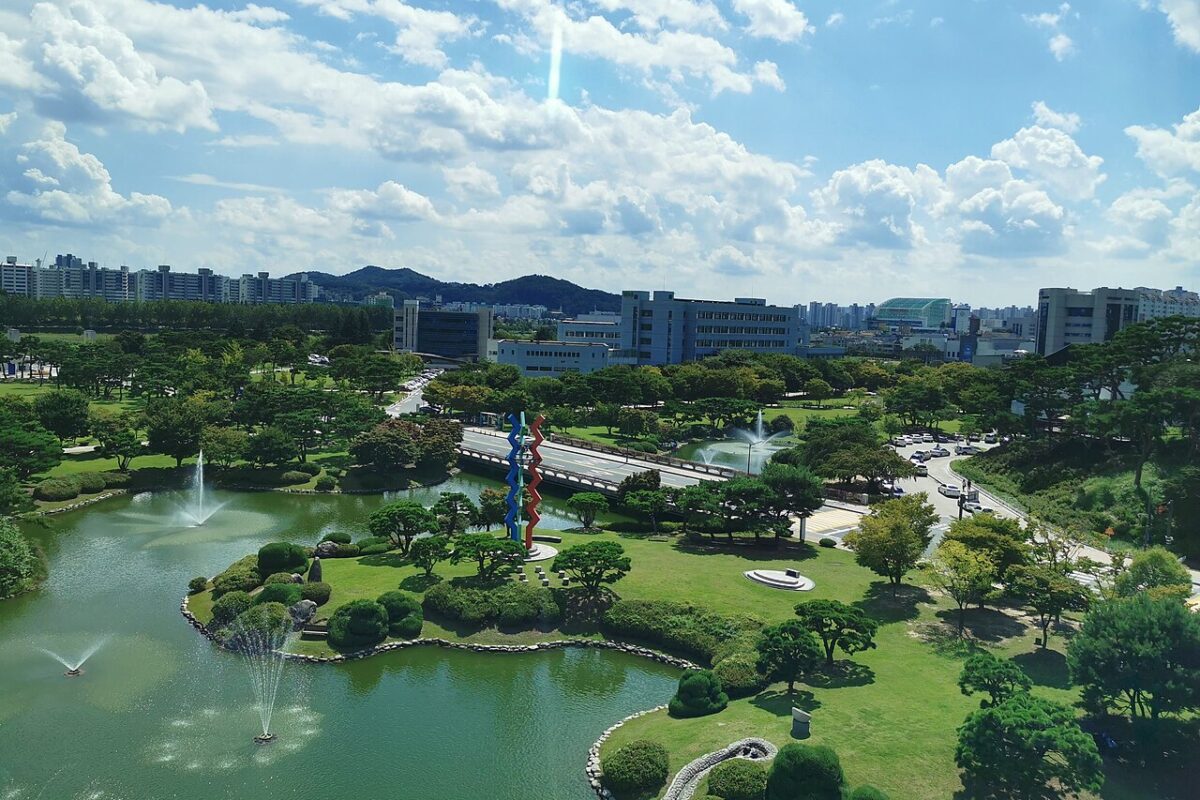
The featured image above shows the KAIST campus pond, fountains and academic buildings in Daejeon — a verified photograph of the university’s own campus. No additional gallery photographs have been added yet: extra campus photos will be added only once each one is verified as KAIST’s own campus. If you have a freely-licensed photograph of the KAIST campus, tell us through the Admission Inquiry page.
Campus and Infrastructure
KAIST is in Daejeon, South Korea’s science city, about an hour from Seoul by high-speed train. The city hosts dozens of national research institutes in the Daedeok Science Town, giving students unusual access to working scientists and research jobs. The campus itself is modern and green, with on-campus housing for most international students.
Faculties and Departments
KAIST offers undergraduate and graduate degrees across computer science, electrical engineering, mechanical engineering, aerospace engineering, artificial intelligence, and business and technology management. All teaching is in English, which makes it one of the most accessible Korean universities for international students. Research is central to the experience — undergraduates are encouraged to join laboratories early, and the university runs its own start-up incubators.
Compare with Similar Universities
Compare universities side by side with our Compare Universities tool — pick any two universities and see their fees, rankings, intakes and degree levels together. Similar universities on this site: Seoul National University (South Korea, QS 2026: joint 38th in the world) — the only other South Korean university on this site.
Frequently Asked Questions
How and when do I apply to KAIST?
There are spring and autumn intakes. The undergraduate autumn regular round closes on 14 January 2027 and graduate autumn applications run from 7 January to 5 February 2027. Check the admissions page on kaist.ac.kr for the current cycle’s dates.
Do I need Korean to study at KAIST?
No — all teaching is in English, so no Korean test is required. The university recommends TOEFL iBT 83, IELTS Academic 6.5, TOEIC 720 or TEPS 326.
How much is tuition at KAIST, and is there a scholarship?
Undergraduate tuition is KRW 3,433,000 per semester, or KRW 6,866,000 per year, before scholarships. In practice, almost every admitted international undergraduate receives the KAIST Scholarship, which pays the full tuition for eight semesters and adds a monthly stipend of KRW 350,000 plus health insurance.
What about funding for master’s and PhD students?
Graduate tuition is KRW 9,559,000 per semester before scholarships, but about 94% of international master’s and PhD students receive similar funding. Check the official KAIST admissions page for the current scholarship terms.
What can I study at KAIST?
KAIST offers undergraduate and graduate degrees across computer science, electrical engineering, mechanical engineering, aerospace engineering, artificial intelligence, and business and technology management. Every student studies science, engineering or technology management.
Scholarships
KAIST Scholarship — pays the full undergraduate tuition for eight semesters and adds a monthly stipend of KRW 350,000 plus health insurance, for almost every admitted international undergraduate. About 94% of international master’s and PhD students receive similar funding — check the official KAIST admissions page for the current scholarship terms. Also see the Global Korea Scholarship (GKS) on this site. Open and closed status is shown on each scholarship’s own page; expired awards are never shown as open.
Address and Location
KAIST
291 Daehak-ro, Yuseong-gu, Daejeon 34141, South Korea