
Quick Information
| Tuition Fee | €20,630–€29,570/year (non-EU undergraduate, 2026/27) |
|---|---|
| Last Verified Date | November 10, 2026 |
Trinity College Dublin, founded in 1592, is Ireland’s oldest university and its highest-ranked, at 75th in the QS World University Rankings 2026. Set in the heart of Dublin, its campus is famous for the Book of Kells and the Long Room library, one of the most photographed libraries in the world. Graduates include Oscar Wilde, Samuel Beckett and Jonathan Swift, and the university combines that heritage with strong modern research in science, technology and medicine.
Course Fees
| Programme | Tuition fee (per year, non-EU, 2026/27) | Notes |
|---|---|---|
| Undergraduate | €20,630–€29,570 | For example Global Business €20,630; Computer Science and Engineering €29,570. Medicine costs up to about €60,000 a year. |
| Taught postgraduate | €17,830–€37,300 | For example MSc Computer Science about €26,000–€27,790; MSc Finance €27,300; MBA €37,300. |
Students also pay annual Student Levies and Charges. Check the exact fee for your programme on the official Trinity fees page before applying: Trinity College Dublin official website.
Student Reviews
We do not publish student reviews written by us, and we do not invent ratings. Read what students and visitors actually say on the university’s real Google Maps reviews: Trinity College Dublin on Google Maps. If you have studied at Trinity and want to share your experience with future applicants, tell us through our Admission Inquiry page.
Admission Process
Non-EU undergraduate applications open on 1 November, with a priority deadline of 1 February and a final deadline of 30 June. Postgraduate applications are generally rolling until 30 June. Study starts in September. Most courses ask for IELTS Academic 6.5 overall with 6.0 in each band, or TOEFL iBT 90. Some courses require the higher band of IELTS 7.0 with 6.5 in each band, or TOEFL iBT 100. Students from outside the EU need an Irish study visa, and graduates can stay on to work under Ireland’s post-study work arrangements — check the official Trinity admissions page for the current visa steps.
| Date | Event |
|---|---|
| 1 November | Non-EU undergraduate applications open |
| 1 February | Priority deadline (non-EU undergraduate) |
| 30 June | Final deadline (non-EU undergraduate); most postgraduate applications close |
| September | Study starts |
This university does not publish a downloadable brochure — check its official admissions page for the latest information.
Placements and Careers
Trinity does not publish a single overall placement or employment rate that we can verify, so none is given here. The university’s careers service supports students and graduates with advice, events and employer connections, and Dublin’s position as a European hub for global technology and pharmaceutical companies gives students strong links to employers. See the official Trinity website for the latest careers information.
Rankings
QS World University Rankings 2026 place Trinity College Dublin 75th in the world — Ireland’s highest-ranked university.
Campus Gallery
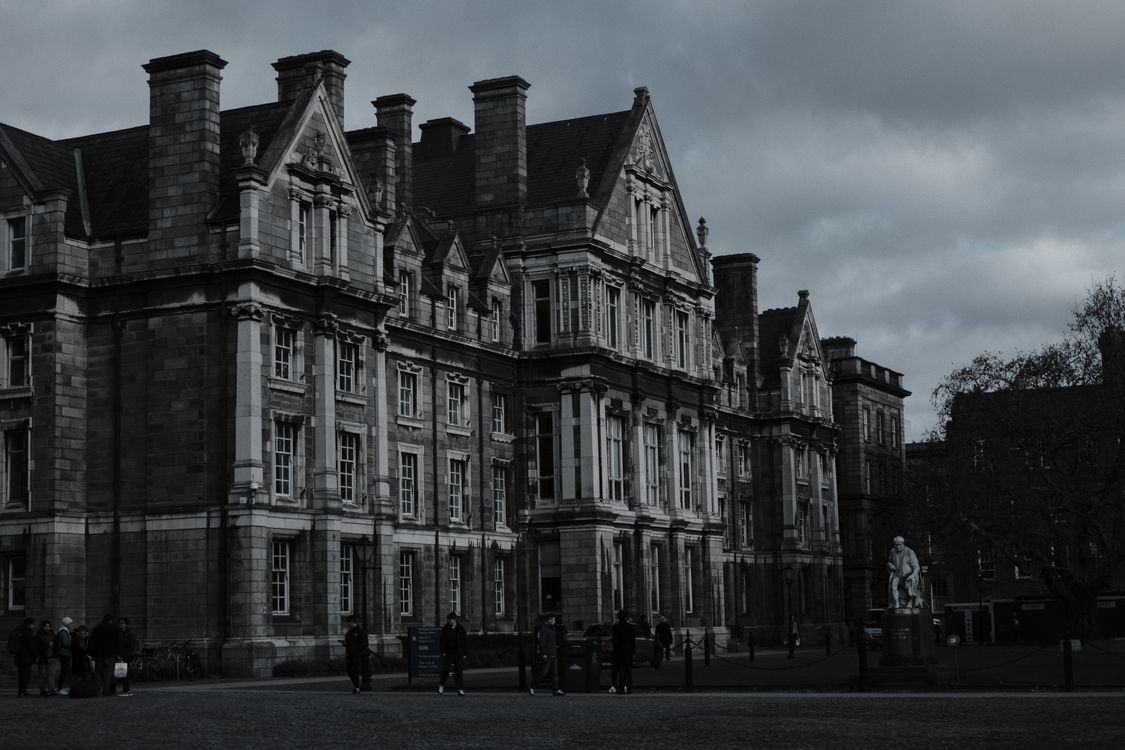
The featured image above shows the Graduates Memorial Building on the Trinity campus — verified as a genuine campus photograph. No additional gallery photographs have been added yet: extra campus photos will be added only once each one is verified as Trinity’s own campus. If you have a freely-licensed photograph of the Trinity campus, tell us through the Admission Inquiry page.
Campus and Infrastructure
Trinity’s campus sits right in Dublin city centre, next to Grafton Street, Temple Bar and the River Liffey. It is a green, historic space in the middle of a busy capital, with libraries, sports grounds, theatres and student societies all within its walls. The campus is famous for the Book of Kells and the Long Room library. Because the campus is so central, students step straight out of lectures into Dublin’s shops, cafés and cultural life.
Faculties and Departments
Trinity is organised in three faculties: Arts, Humanities and Social Sciences; Engineering, Mathematics and Science; and Health Sciences. Trinity’s most popular courses for international students include computer science, business, law, medicine, engineering and nursing. The university is known for the quality of its teaching in the humanities as well as the sciences.
Compare with Similar Universities
Compare universities side by side with our Compare Universities tool — pick any two universities and see their fees, rankings, intakes and degree levels together. Trinity is the only university in Ireland on this site. The closest peers on this site by level and subject are: University of Edinburgh (QS 2026: 34th in the world) and University of Cambridge (QS 2026: 6th in the world).
Frequently Asked Questions
How and when do international students apply to Trinity?
Non-EU undergraduate applications open on 1 November, with a priority deadline of 1 February and a final deadline of 30 June. Postgraduate applications are generally rolling until 30 June. Study starts in September.
What English score does Trinity ask for?
Most courses ask for IELTS Academic 6.5 overall with 6.0 in each band, or TOEFL iBT 90. Some courses require the higher band of IELTS 7.0 with 6.5 in each band, or TOEFL iBT 100.
How much is tuition at Trinity for non-EU students?
Non-EU undergraduate tuition for 2026/27 ranges from €20,630 a year for business to €29,570 a year for computer science and engineering, with medicine costing up to about €60,000 a year. Taught postgraduate courses cost between €17,830 and €37,300 a year, with the MBA at the top of that range. Students also pay annual Student Levies and Charges.
Do I need a visa to study at Trinity?
Students from outside the EU need an Irish study visa. Graduates can stay on to work under Ireland’s post-study work arrangements — check the official Trinity admissions page on tcd.ie for the current visa steps.
What can I study at Trinity?
Trinity’s most popular courses for international students include computer science, business, law, medicine, engineering and nursing. The university is known for the quality of its teaching in the humanities as well as the sciences.
Scholarships
Trinity’s own scholarships are listed on the official Trinity website — check the funding pages on tcd.ie for the current awards, eligibility and deadlines. Also see the Government of Ireland International Education Scholarship on this site. Open and closed status is shown on each scholarship’s own page; expired awards are never shown as open.
Address and Location
Trinity College Dublin
College Green, Dublin 2, D02 PN40, Ireland